 Wundur
About
Why Wundur exists
I make small games with AI, and some of them I make with my son.
For a long time the hard part wasn't the code. Claude Code and Cursor are good at code. It was everything around it: a picture made in one tool, a 3D model in another, sound somewhere else, and the agent in a terminal that scrolled past faster than I could read. Wundur started as a better window for the agent, under the name Keleuo, and over time it turned into the place where the whole game comes together. So it got a new name.
What AI can and can't do
AI can make a decent character now, a sound effect, a rough 3D model. It can't make a great game by itself, and it's nowhere near replacing the artists, designers and programmers who make games for a living. I don't want Wundur to pretend otherwise. It won't turn one person into a AAA studio. It's for making your own thing, at the size one person, or a parent and a kid, can actually finish.
The models make the pieces. The art is the world you put together.
Everything Wundur makes for you is AI-made, and it doesn't hide that. For each piece it keeps a record of what was asked, what it was made from and what you approved.
What it does
Making a piece of a game is a guided path, and you approve each step before the next one starts. It begins with quick concept images from your description, which you pick from or change in your own words. Then come three views of the chosen concept, front, side and back, then a 3D model built from them that you can turn around in a viewer beside the chat. Rigging, so a character can walk and run, is the next step to join the path. Until it does, the agent can already rig a model from the chat.
Everything lands in your own project as ordinary files, PNG, GLB and FBX, so it goes into whatever engine you use. Wundur isn't tied to an engine and doesn't try to be one. The images and models come from services you connect with your own keys: OpenAI or Azure for pictures, Tripo for 3D, ElevenLabs for sound, voices and music.
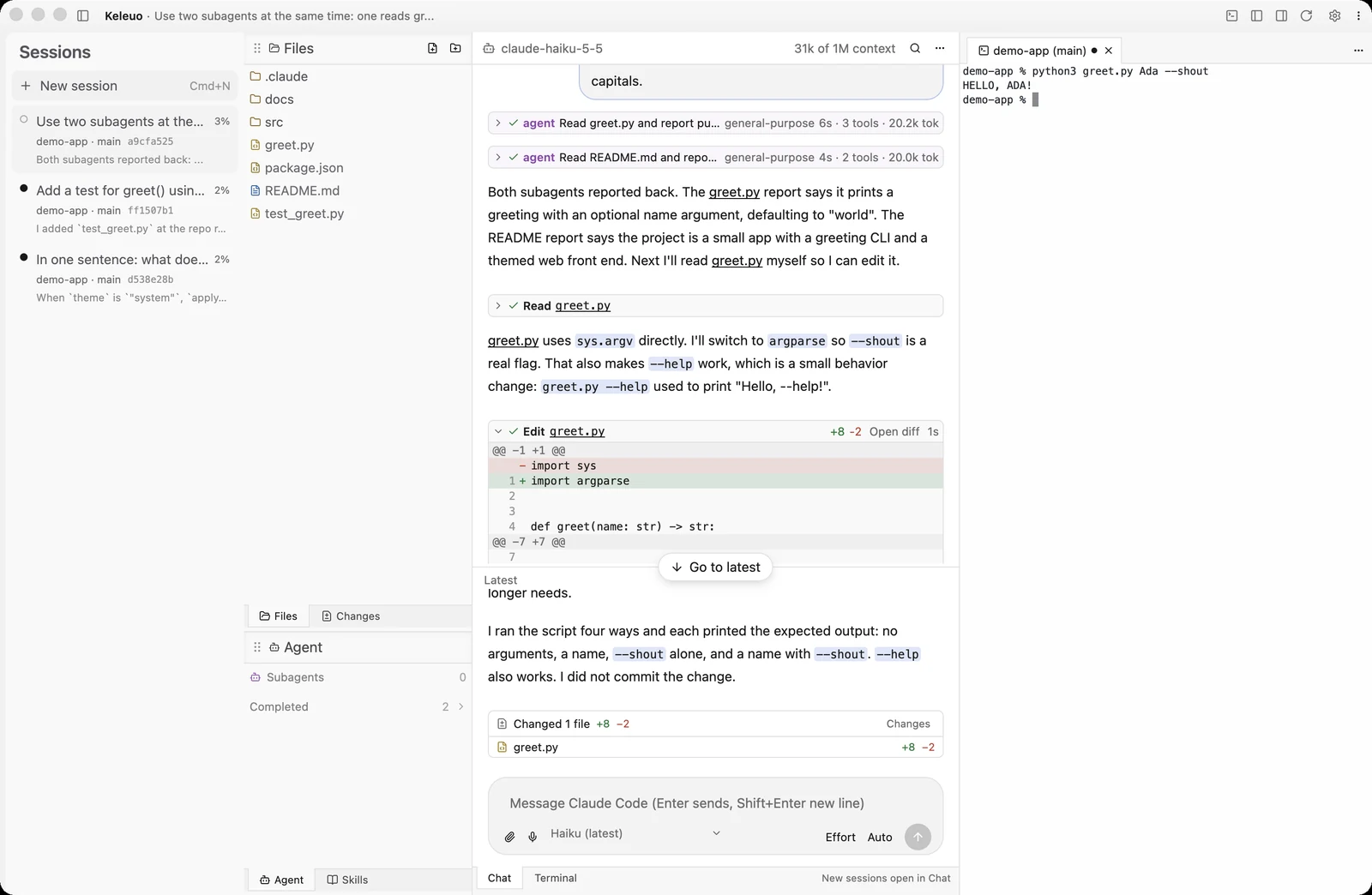
You don't have to be making a game, either. Wundur is also a good replacement for running an agent in a terminal:
- The conversation reads like a chat: Markdown rendered, tool calls folded into cards, real diffs, file references you can click, subagents as they run.
- Each turn ends with a list of the files it changed, and each one opens as a diff.
- Permission prompts and questions arrive as buttons, and the session list shows which sessions need you.
- Files, an editor, terminals and the agent's skills share the window with the session.
Wundur isn't an agent and doesn't compete with the people who build them. Anthropic, OpenAI and Cursor have whole teams on that, so Wundur runs Claude Code and Cursor Agent exactly as they ship, and their own terminal interface is always one click away.
Making games with your kids
Kids are full of game ideas, and an agent can help them get one out of their head and onto the screen. If they use Wundur on their own, parent mode keeps the agent a tool rather than a friend. It stays on the project, says plainly that it's an AI tool if a child treats it like a person, and never asks for personal details. It alerts a parent when something needs attention, without ever showing what the child wrote.
What's coming
Rigging is the next step for the guided path. Sign in with Wundur, and a hosted service to go with it, are coming later.
Built native
Wundur is written in Rust on gpui, the GPU-accelerated framework behind the Zed editor. There's no browser engine inside, so it opens quickly, stays small and feels like part of the machine.
Built with its own tools
Wundur is built with Claude Code, inside Wundur. The log is written the same way: Claude drafts each entry from that day's commits, and I read it over before it goes up.
Open source
Wundur is free and open source under the Apache 2.0 License. Issues, ideas and pull requests are welcome on GitHub.
Wundur is published by Wundur AI Learning, LLC. It works with Claude Code and Cursor Agent, and is not affiliated with Anthropic, OpenAI, Cursor, Tripo or ElevenLabs.